Integrals in calculus classes are often introduced as representing the area under a curve. When the curve happens to be a rate of change for some quantity, this area in turn represents the change in that quantity over some interval of time.
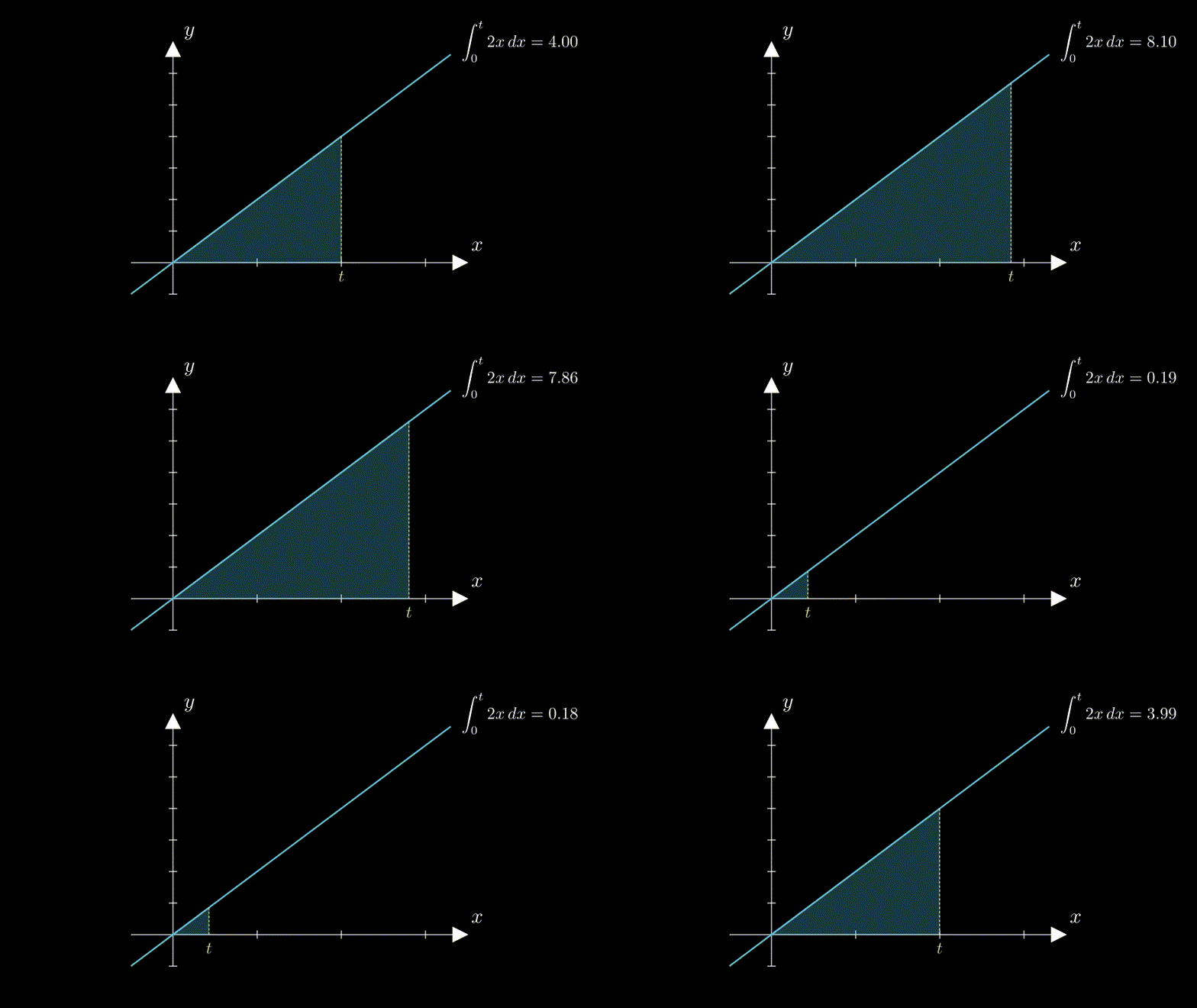
As was the case with differentiation, we should take a broader and more abstract perspective before generalizing to complex numbers. An integral $$\int_{x_1}^{x_2}f(x)\,dx$$ is an infinite sum, whose terms are the values $f(x_1)$, $f(x_2)$ and everything in between, and are weighted by infinitesmal weights $dx$ that sum to $x_2 - x_1$. (This notion is made formal through Riemann sums).
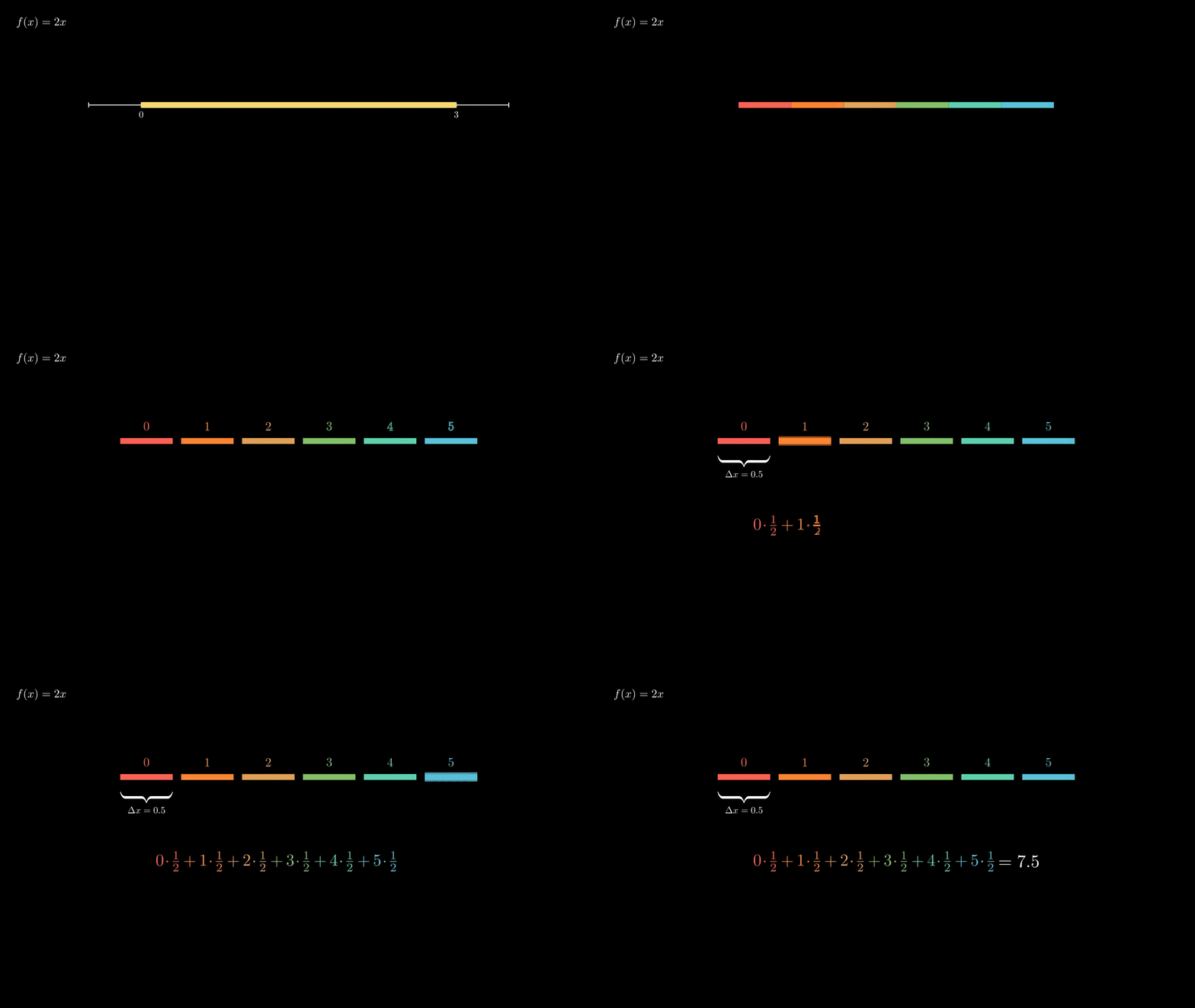
With some thought, we can see how we might analogously think about integrating a function $g: \mathbb{C} \rightarrow \mathbb{C}$. In $\mathbb{R}$, we take a path from $x_1$ to $x_2$. Then we break it into pieces and evaluate $f$ at each piece. Finally, we sum these outputs of $f$, with weights determined by the lengths of the pieces. The integral is obtained by letting the number of pieces go to infinity.
(Food for thought: do the sizes of the pieces need to be uniform?)
One subtlety in the previous paragraph lies in the phrase "take a path from $x_1$ to $x_2$". In $\mathbb{C}$, the first problem we encounter is that there are infinitely many paths from $z_1$ to $z_2$. It is not clear whether the value of our integral should depend on the chosen path. Thus, to begin with, we take an intergral in $\mathbb{C}$ with respect to, or over, a particular path (called a contour).
The rest is pretty much the same. We break the selected path into pieces. Then we evaluate $g$ at each piece. Finally, we calculate a weighted sum of the results. This time, the weights $\Delta{z_k}$, is the displacement across a piece, expressed as a complex number. The integral is obtained by letting the number of pieces go to infinity.
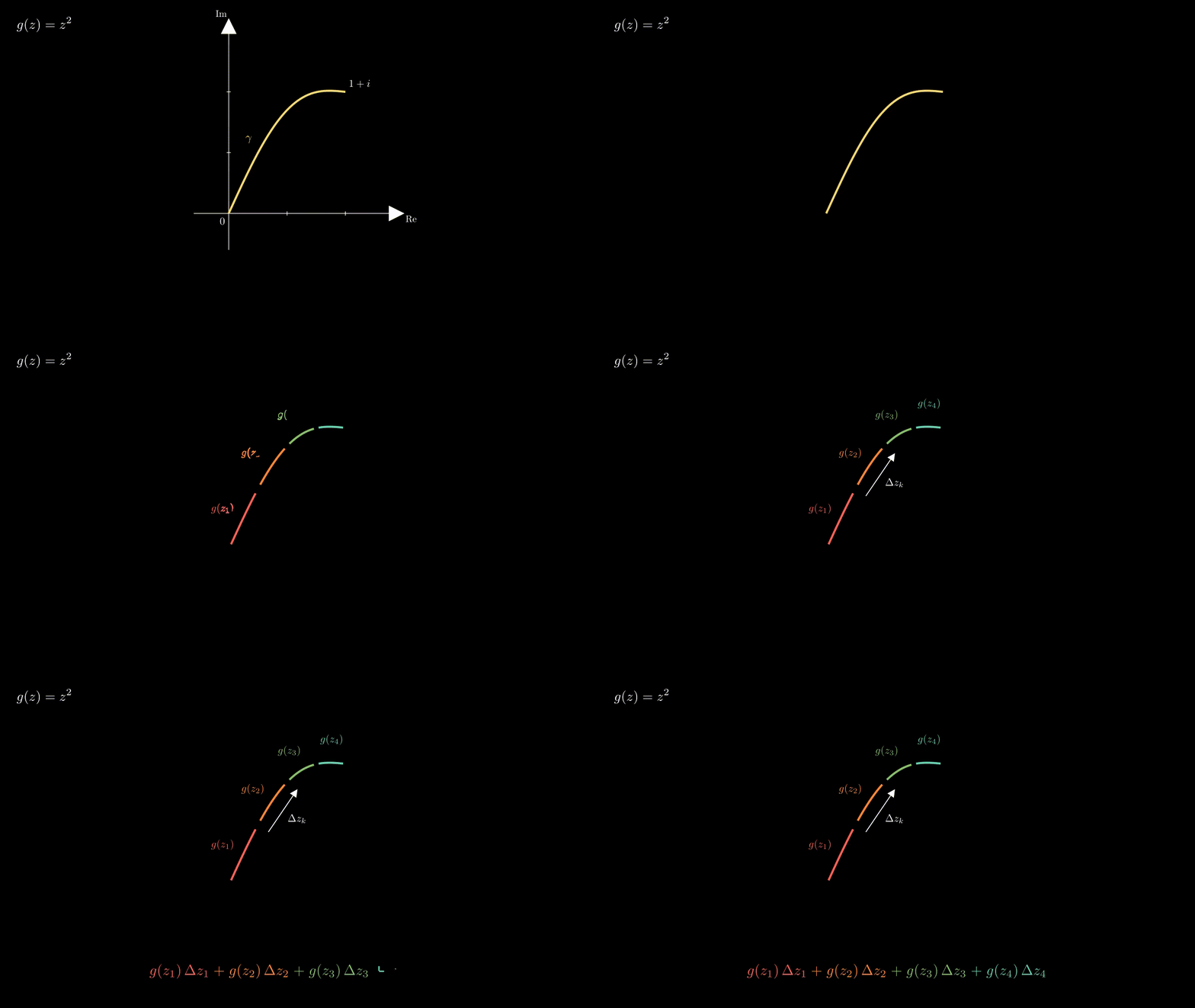
Above is a crude Riemann sum for $\int_{\gamma}z^2\,dz$, where the contour $\gamma$ is parametrized by $z(t) = t + i(t + 0.35\sin(\pi{t}))$ for $t \in [0, 1]$. How we split the contour into parts is determined by the step size $\Delta{t} = 0.25$; that is, the $k$-th part is parametrized by $z(t)$ for $t \in [0.25(k - 1), 0.25k)$. Let's try evaluating this very crude Riemann sum. We'll see how it compares to the value of the integral at the end.
(Additional food for thought: we split the contour $\gamma$ into parts at the points $z(0.25)$, $z(0.5)$, $z(0.75)$. As a result, each part has a different length in the complex plane. Alternatively, we could have split the contour into parts of equal length, as in the real case. Does the approach we take affect the eventual value of the integral, when we let the number of parts go to infinity? Why or why not?)
Evaluate $z(t)$ at the left endpoints $t = 0,\; 0.25,\; 0.5,\; 0.75$. Round to 2 decimal places.
Recall $g(z) = z^2$. Square each $z_k$ from Step 1. Round to 2 decimal places.
$\Delta z_k = z(t_k) - z(t_{k-1})$, the complex displacement across each piece. Round to 2 decimal places.
Multiply and add the results from Steps 2 and 3. Round to 2 decimal places.