(You're advised to read the first post in this sequence before this one).
So the derivative of a complex-valued function $g$ at $z_0$ is the complex number approached by $\frac{\Delta{g}}{\Delta{z}}$ as $\Delta{z} \rightarrow 0$. With this in mind, we should note that the derivative of a function $g$ need not exist at $z_0$.
Before we identify requirements for differentiability in $\mathbb{C}$, let's recall what non-differentiability looks like in $\mathbb{R}$. Consider the classic example of $f:\mathbb{R} \rightarrow \mathbb{R}$ by $f(x) = |x|$. As before, we'll position $x_0$ at $0$ and think about what happens to $\frac{\Delta{f}}{\Delta{x}}$ as $x \rightarrow 0$.
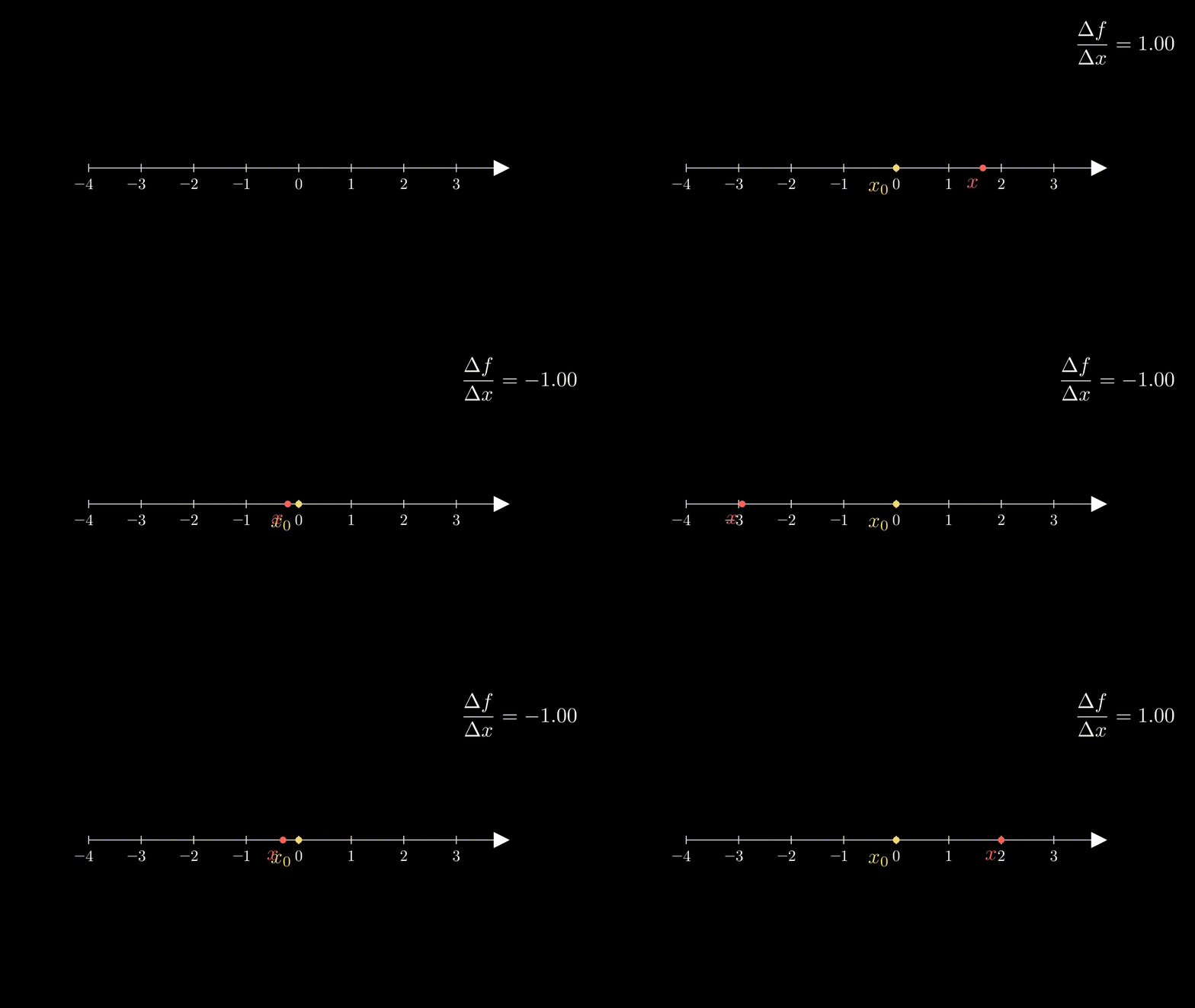
No matter how much we zoom in on $x_0 = 0$ the ratio $\frac{\Delta{f}}{\Delta{x}}$ does not approach a constant in the surrounding region. Try zooming in for yourself below: we always have $\frac{\Delta{f}}{\Delta{x}} = -1$ to the left of $x_0 = 0$, and $\frac{\Delta{f}}{\Delta{x}} = +1$ to the right.
Thus, for a function $f: \mathbb{R} \rightarrow \mathbb{R}$ to be differentiable at $x_0$, we must have that $\frac{\Delta{f}}{\Delta{x}}$ is approximately equal, whether we take $x = x_0 + \varepsilon$ or $x = x_0 - \varepsilon$ (for small $\varepsilon > 0$). In $\mathbb{R}$, there are only two directions from which $x$ can approach $x_0$. In $\mathbb{C}$, $z$ can approach $z_0$ from infinitely many directions, making this constraint much stronger.
Now let $g: \mathbb{C} \rightarrow \mathbb{C}$, and write $g(z) = u(x, y) + iv(x, y)$, where $z = x + iy$ and $u, v: \mathbb{R}^2 \rightarrow \mathbb{R}$ are the real and imaginary parts of $g$.
We want conditions on $g$ equivalent to differentiability. One natural strategy is to assume that differentiability holds, and deduce what must follow.
We do that here. First, suppose $g(z) = u(x, y) + iv(x, y)$ is differentiable at $z_0$. Then $u(x, y)$ and $v(x, y)$ must have first-order partial derivatives. (If you want to try proving why, submit your proof or a sketch of one below. It will be graded by an LLM. Alternatively, request a hint or click to reveal the answer!)
Now $\frac{\Delta{g}}{\Delta{z}} = \frac{\Delta{u} + i\Delta{v}}{\Delta{z}}$. Recall that for $g'(z_0)$ to exist, this must converge to the same value no matter how $z \to z_0$. Let $\Delta{t} > 0$ be a small real number, and note that $\frac{\Delta{g}}{\Delta{z}}$ should be approximately equal, whether we take $z = z_0 + i\Delta{t}$ or $z = z_0 + \Delta{t}$.
If we take $z = z_0 + \Delta{t}$, we have $$\begin{equation*} \begin{split} \frac{\Delta{g}}{\Delta{z}} &= \frac{\Delta{u} + i\Delta{v}}{\Delta{t}} \\ &= \frac{\Delta{u}}{\Delta{t}} + i\frac{\Delta{v}}{\Delta{t}} \\ &\xrightarrow{\Delta{t} \to 0} \frac{\partial{u}}{\partial{x}} + i\frac{\partial{v}}{\partial{x}} \end{split} \end{equation*}.$$
On the other hand, if we take $z = z_0 + i\Delta{t}$, we have $$\begin{equation*} \begin{split} \frac{\Delta{g}}{\Delta{z}} &= \frac{\Delta{u} + i\Delta{v}}{i\Delta{t}} \\ &= -i\frac{\Delta{u}}{\Delta{t}} + \frac{\Delta{v}}{\Delta{t}} \\ &\xrightarrow{\Delta{t} \to 0} -i\frac{\partial{u}}{\partial{y}} + \frac{\partial{v}}{\partial{y}} \end{split} \end{equation*}.$$
Since both expressions equal $g'(z_0)$, they must equal each other. Equating real and imaginary parts, we obtain $$\frac{\partial{u}}{\partial{x}} = \frac{\partial{v}}{\partial{y}}$$ and $$\frac{\partial{v}}{\partial{x}} = -\frac{\partial{u}}{\partial{y}}.$$ These two conditions constitute the Cauchy-Riemann Equations.
Notice that we only checked two directions of approach: horizontal and vertical. It turns out these two suffice! Checking other directions yields no new equations, since $\frac{\Delta g}{\Delta z}$ along any direction can be expressed in terms of the same four partial derivatives. In the next post, we will prove that these necessary conditions are sufficient, provided the partial derivatives of $u$ and $v$ are continuous.